
The Restoration story most members know starts with a question. In the 1838 account (Joseph Smith—History, every missionary flip chart), fourteen-year-old Joseph walks into the woods near Palmyra, troubled by competing churches, and asks God which denomination is right. The lessons set the hook with Joseph’s honest seeking and provide a foreshadowing solution, simply ask God, for “if any of you lack wisdom, let him ask of God.”
That setup matters. If Joseph went as an open-minded seeker, the answer recorded in 1838 (all churches wrong, join none of them) functions as a divine call to restore Christianity. The Church, through leaders, instructors and curriculum, train missionaries to present it this way. Members testify that the story is true. Leaders such as Lawrence Corbridge treat “Was Joseph Smith a prophet?” as a primary questions meant to settle any “secondary” concerns about history, culture, or harm. He’d have us ignore this glaring difference in the first vision accounts as noise, but the omission drastically changes the story and motives of Joseph Smith.
Joseph’s earliest surviving written account points in a different direction. In his own hand, in 1832, he reports that scripture study had already convinced him every church had apostatized. He went to pray for forgiveness, not to choose a denomination. That claim is not anonymous rumor. It appears in the 1832 history, published through the Church’s Joseph Smith Papers project, and it does not align cleanly with the correlated version taught in lessons and missionary discussions.
What Narrative Does The Church Teach?
In Joseph Smith—History (1838, Pearl of Great Price), Joseph describes Palmyra’s religious excitement, sectarian confusion, and a personal crisis:
Who of all these parties are right; or, are they all wrong together? If any one of them be right, which is it, and how shall I know it?
He reads James 1:5, prays, and in the grove sees two personages, the Father and the Son. He asks which sect is right. He is told to join none of them, that their creeds “were an abomination,” and that he would learn more later. Correlated teaching, from the 1838 account, emphasizes Joseph’s surprise and astonishment: “It had never entered into my heart that all were wrong.”
Gordon B. Hinckley stated the institutional stakes plainly: if the First Vision “did not occur,” he said, “this work is a fraud.”

A Document Problem
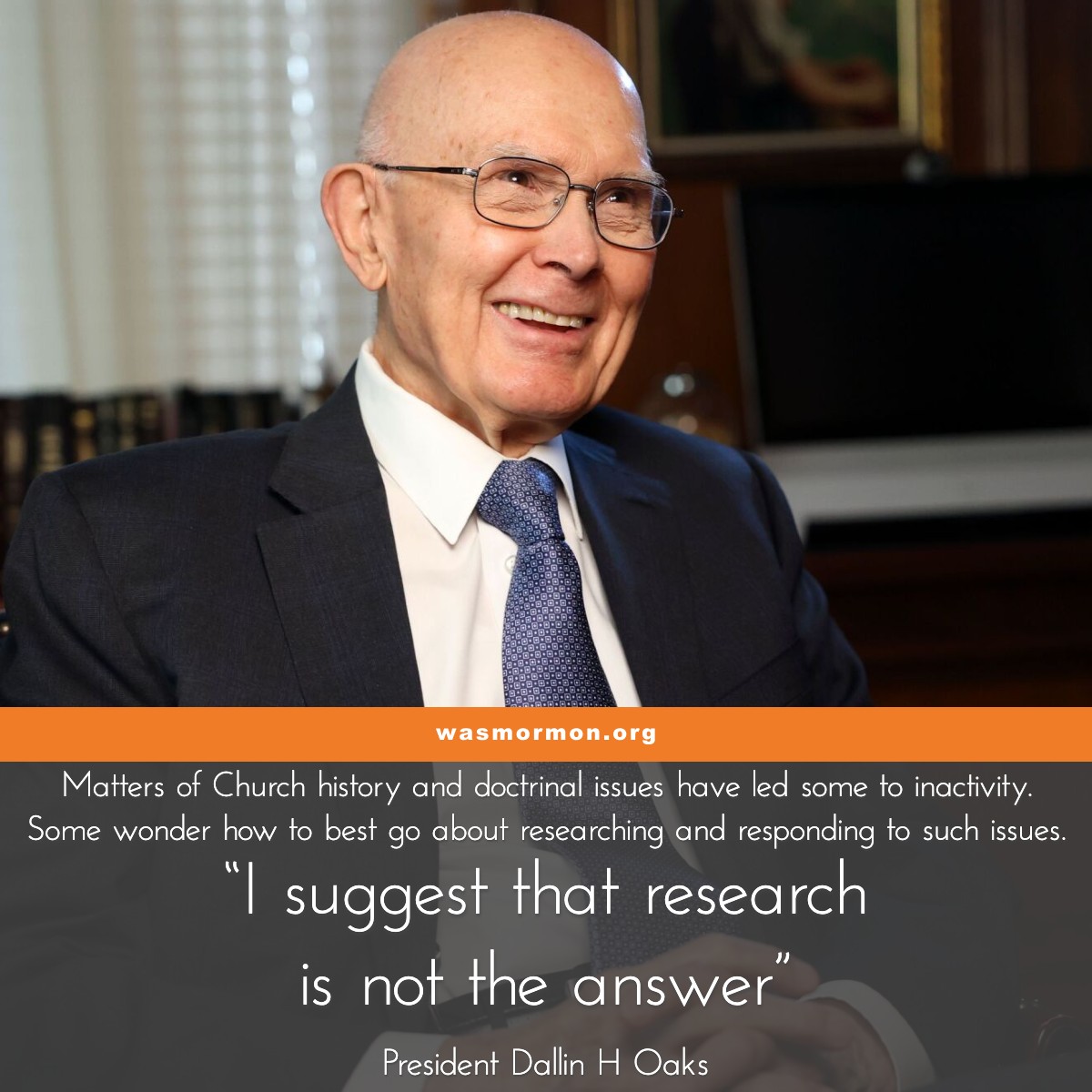
The Church’s habit of dismissing First Vision criticism as “anti-Mormon” sidesteps a simple test: read the documents. They are publicly available. Though the church leaders know this, they even caution members not to read documents or research, Oaks, current church president, has said it multiple times, when faced with confusing or conflicting thoughts on church history, “research is not the answer.” But what can researching the documents and historical record tell us?
Joseph did not write the 1838 history in his own hand. Scribes drafted it under his direction for a larger church history project, roughly eighteen years after the First Vision was said to have occurred. By then he had founded a church, published the Book of Mormon, led the Saints through Ohio and Missouri, dedicated the Kirtland Temple, weathered the Kirtland Safety Society collapse, and was embroiled in the conflicts that produced the 1838 Missouri narrative. The 1838 text reads as a retrospective founding story, not a contemporary record from 1820.
The 1832 account, in Joseph’s handwriting in his letterbook, remains the earliest written version on record. No Palmyra newspaper, neighbor’s diary, or local letter from 1820 describes a vision in the grove. The first written telling dates to about twelve years later. That silence does not by itself disprove an 1820 experience; it does show that modern certainty outruns the contemporary record. On how slowly the story entered early Mormon consciousness, see The First Vision Irrelevant To Early Mormon Church.
What Joseph Wrote in 1832
In 1832, Joseph does not frame the prayer as “which church should I join?” Before praying, he says scripture study had already convinced him that humanity had apostatized and that no society or denomination was built on the gospel of Jesus Christ:

…by searching the scriptures I found that mankind did not come unto the Lord but that they had apostatised from the true and liv[e]ing faith and there was no society or denomination that built upon the gospel of Jesus Christ…
He describes the prayer as a plea for mercy. In this account Joseph reports one divine being (“the Lord”), not two. The stated motive is forgiveness, not denominational choice. The “which church is true?” arc is not part of his “vision,” but his own conclusion prior to praying. Conflating the question and vision originates in the later 1838 retelling is demonstrably and historically inaccurate.
The 1832 account states that he found, by searching the scriptures, that man had apostatized and there was no denomination built upon the gospel.
The 1838 account directly contradicts this and states “how to act I did not know, and unless I could get more wisdom than I then had, I would never know; for the teachers of religion of the different sects understood the same passages of scripture so differently as to destroy all confidence in settling the question by an appeal to the Bible… So, in accordance with this, my determination to ask of God, I retired to the woods to make the attempt… My object in going to inquire of the Lord was to know which of all the sects was right, that I might know which to join… I asked the Personages who stood above me in the light, which of all the sects was right (for at this time it had never entered into my heart that all were wrong)—and which I should join. I was answered that I must join none of them, for they were all wrong; and the Personage who addressed me said that all their creeds were an abomination in his sight; that those professors were all corrupt.. He again forbade me to join with any of them” (Joseph Smith—History 1:10-20).

The 1832 account was not published in Joseph’s lifetime. Historians later recovered them from Church custody; at one point the “strange” account was even cut out of Joseph’s letterbook and stored separately in the church president’s safe.
Meanwhile the 1838 account wasn’t popularized at the time. It was written in 1838, 18 years after the alleged story, and still no one knew about it then. The church still didn’t teach about it. The history wasn’t taught by the church until it was canonized in 1880, more than 40 more years later and 60 years after the event. Here’s when the story begins to become known by the members, and it takes another couple generations to become the foundational event it’s made out to be today.

But when the new version surfaced, in the 1970s, the church doubled down on the official account. Today, they continue to dismiss any differences as inconsequential with phrases like, “this discrepancy doesn’t undermine the basic message of Joseph’s First Vision accounts.”

Why the Shift Matters
If Joseph had already concluded that all churches were false before he prayed, the 1838 line that it had “never entered into my heart that all were wrong” conflicts with his own words in his earlier draft. If he prayed for forgiveness, the image of a humble seeker asking “which church?” reflects a later emphasis, not the earliest written record.
Apologists often describe the accounts as complementary: different audiences, same event. The Church’s Gospel Topics essay on First Vision accounts acknowledges multiple accounts and maintains they harmonize. Material once labeled “anti-Mormon” has repeatedly surfaced in official footnotes. That pattern matches the “primary vs. secondary” framework Corbridge promotes.
What the Family Did in the 1820s
The 1838 account reports that God told Joseph not to join any church. The Smith family’s church activity in the 1820s does not consistently reflect that command.
Lucy Mack Smith’s memoir describes a revival after Alvin’s death in 1823 during which the family sought comfort. John Matzko, summarizing Lucy and other sources in Dialogue, writes:
Rather than being repelled by Stockton’s preaching, sometime before 1828 Lucy and three of her children—Hyrum, Samuel, and Sophronia—joined the Presbyterian church where Stockton was the pastor.
John Matzko, “The Encounter of the Young Joseph Smith with Presbyterianism,” Dialogue
The Church’s own First Vision Accounts FAQ acknowledges that this timeline is difficult to reconcile with the canonical 1838 story.
Joseph’s own relationship to Protestant fellowship complicates the dominant narrative picture further. Matzko notes statements attributed to Joseph that his “mind became somewhat partial to the Methodist sect” and that he “felt some desire to be united with them,” and reports that after Emma’s first pregnancy ended in stillbirth, Joseph “briefly joined a Methodist class meeting” at the home of her uncle, the Reverend Nathaniel Lewis. Matzko also records Lucy’s report that Joseph warned her joining Presbyterians would do the family “no injury” but that she did not grasp “the wickedness of their hearts.” When Joseph told his mother about his earliest vision, Matzko adds, he did not say all sects were equally wrong; he only said that “Presbyterianism [was] not true.”
None of this disproves a grove experience on its own. But taken together, the records undermine the tidy romanticized sequence often taught: sincere seeker asks which church is true, receives a prohibition on joining any church, and lives accordingly.
Hinckley’s Stakes vs. the Church’s FAQ
It is unclear whether Joseph Smith in his later account misremembered the period when his family members joined the Presbyterian church, whether Lucy Smith misremembered the date, or whether she described a separate series of events. This discrepancy doesn’t undermine the basic message of Joseph’s First Vision accounts.
— First Vision Accounts FAQ, Church of Jesus Christ of Latter-day Saints
Hinckley’s “fraud” line assigns maximum weight to the vision as popularly taught. The FAQ, by contrast, treats factual mismatches as possible memory problems that do not affect the “basic message.”
Share Your Experience
Many members learn the grove story years before they encounter the 1832 account. Missionaries and Sunday School lessons rarely foreground the handwriting in the letterbook or the Presbyterian and Methodist context in the 1820s. When those sources surface, the mismatch with correlated narrative destabilizes trust in the dominant narrative as well as the institution.
wasmormon.org collects member experiences alongside historical sources. Readers who discovered the 1832 account, the family’s Presbyterian affiliations, or Joseph’s Methodist ties during a faith transition are invited to share their story.
More reading
- Joseph Smith and “The” “First” “Vision”
- The Suppressed First Vision Account of 1832
- The First Vision Irrelevant To Early Mormon Church
- Misleading Mormon Thoughts On The First Vision Since 1970
- If The First Vision Did Not Occur, This Work Is A Fraud – Hinckley
- Mormons Expected to Stand Forever – Despite Questions
- The Encounter of the Young Joseph Smith with Presbyterianism (Dialogue)
- 1832 history — Joseph Smith Papers